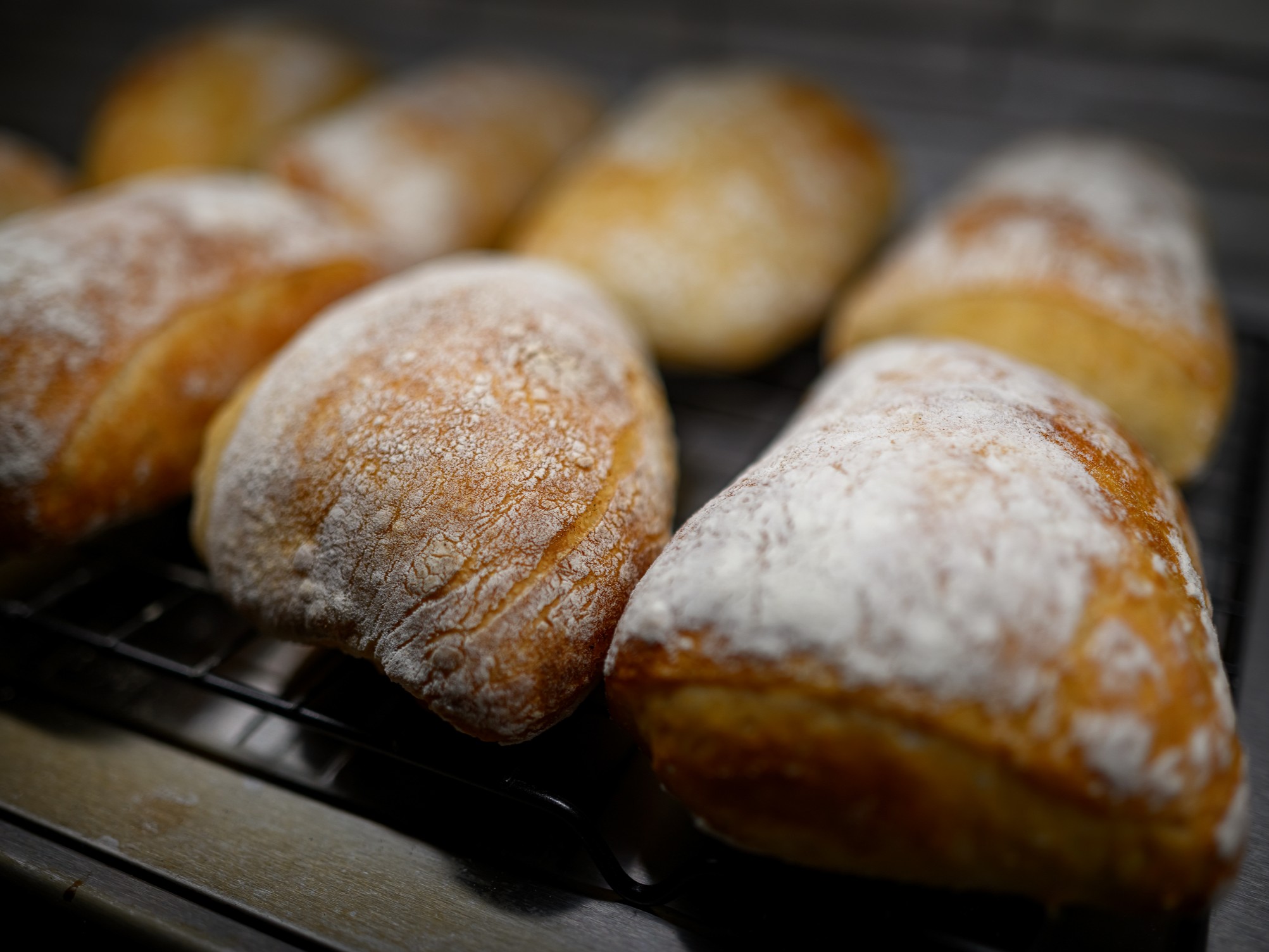
The image captures a batch of olive oil ciabatta loaves resting on a cooling rack, their flour-dusted exteriors highlighted in soft natural light. The crust shows a gentle crackle with a light golden hue, an indicator of well-developed Maillard reaction. The loaves have a slightly irregular but appealing artisanal shape, with a moderate oven spring. The flour dusting adds to the rustic look, though it might obscure some of the surface sheen which typically signifies olive oil inclusion. The overall structural integrity suggests good gluten development, yet the uniformity in shape could be improved with more consistent shaping technique.
**Whispers of Olive** The image captures a batch of olive oil ciabatta loaves resting on a cooling rack, their flour-dusted exteriors highlighted in soft natural light. The crust shows a gentle crackle with a light golden hue, an indicator of well-developed Maillard reaction. The loaves have a slightly irregular but appealing artisanal shape, with a moderate oven spring. The flour dusting adds to the rustic look, though it might obscure some of the surface sheen which typically signifies olive oil inclusion. The overall structural integrity suggests good gluten development, yet the uniformity in shape could be improved with more consistent shaping technique. The light crackling of the ciabatta's crust indicates controlled steam exposure. Creating steam at the start of baking prevents the crust from setting too quickly, allowing the bread to expand and develop a more open internal crumb and a thinner, delicate crust. Correct steam practice is crucial, especially for high hydration doughs like this one. The ciabatta, though traditionally Italian, shares its high hydration characteristic with certain types of French breads. Similar dough hydration levels are found in baguettes, where the goal is also to achieve an airy crumb and a thin crust.