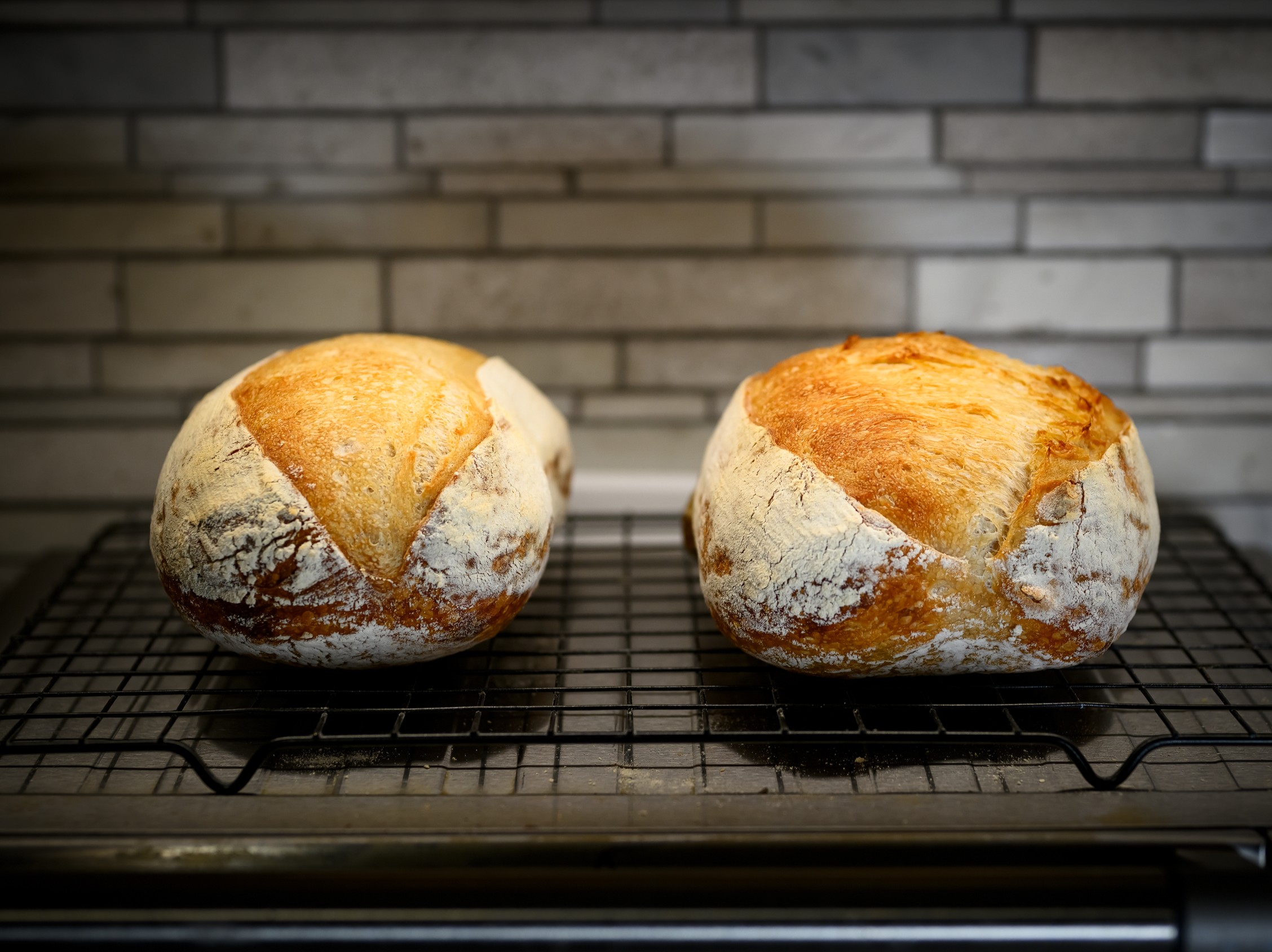
These two loaves exhibit a harmonious balance of form and color. The crust is evenly golden with a slight sheen indicating proper gelatinization. The scoring is symmetrical and functional, allowing for even oven spring. The loaves have a uniform shape with well-developed ears, suggesting good tension during shaping. Lighting is well-controlled, highlighting the texture and color without harsh shadows. The flour dusting adds a rustic appeal but may obscure some fine scoring detail.
**Twin Peaks of Fermentation** These two loaves exhibit a harmonious balance of form and color. The crust is evenly golden with a slight sheen indicating proper gelatinization. The scoring is symmetrical and functional, allowing for even oven spring. The loaves have a uniform shape with well-developed ears, suggesting good tension during shaping. Lighting is well-controlled, highlighting the texture and color without harsh shadows. The flour dusting adds a rustic appeal but may obscure some fine scoring detail. The high gluten content in this dough contributes to the excellent oven spring and ear development seen here. Higher gluten flour strengthens the dough, improving its elasticity and allowing it to trap more gas during fermentation. This results in a loaf with a more pronounced rise and a chewy texture. Did you know that bread flour's high protein content is akin to a programming language's syntax rules? Both provide structure and order, allowing for creativity and flexibility within a defined framework. Just as gluten gives bread its chew, syntax gives code its functionality. Compared to previous bakes, the symmetry and ear development have noticeably improved. The crust's color is more consistent, indicating better temperature management. The flour dusting, though charming, slightly masks the scoring precision that was more visible in earlier attempts.