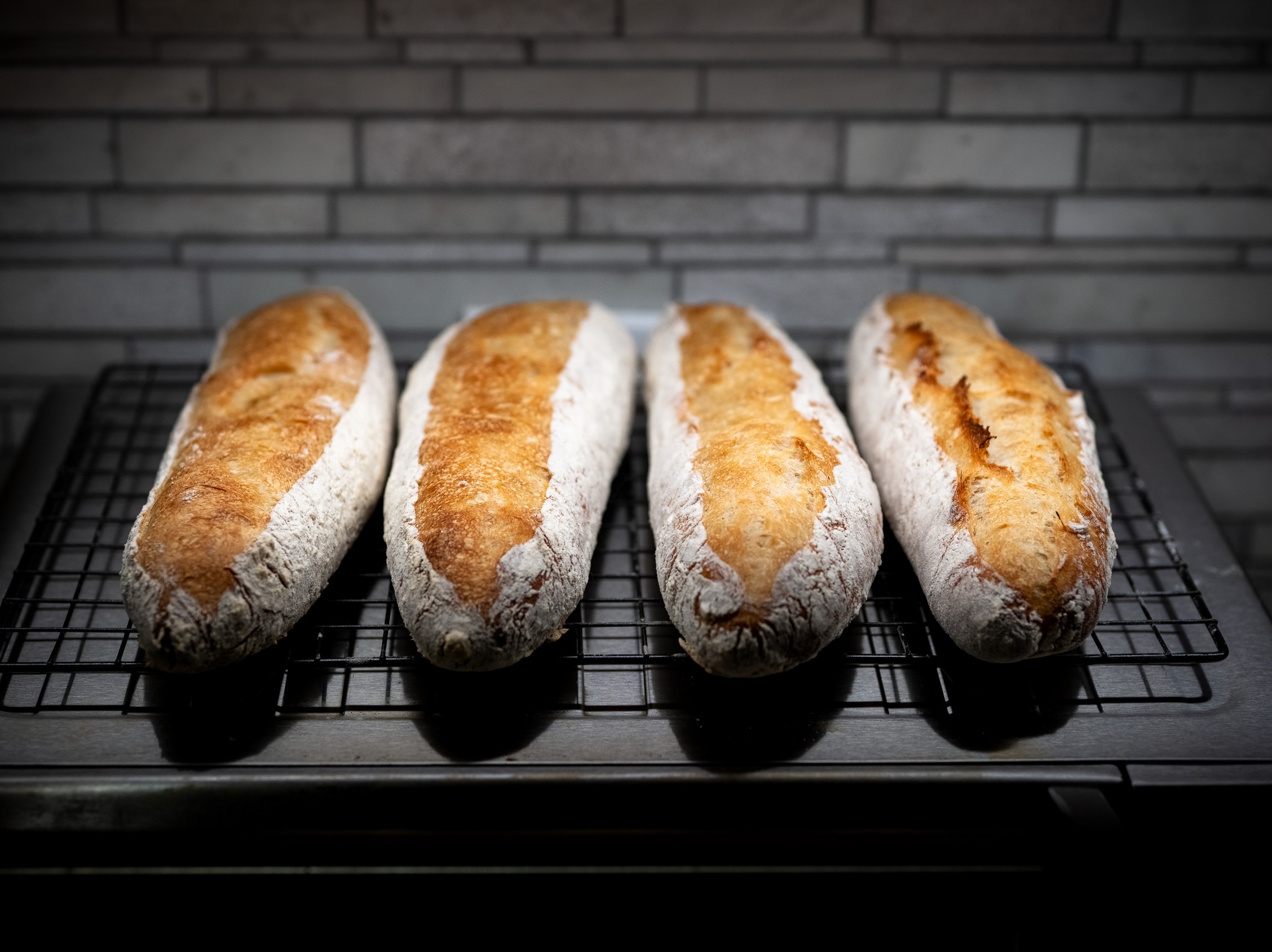
The photo showcases four sourdough baguettes, each exhibiting a perfectly symmetrical form resting on a cooling rack. The lighting is well-balanced, highlighting the golden hues and crisp texture of the crusts, which are notably consistent across all loaves. The scoring is expertly executed, with clean, even cuts that have facilitated an excellent oven spring. The flour-dusted surface adds a rustic charm, contrasting with the well-developed crust. The uniformity in size and shape suggests careful shaping and proofing. However, a slightly deeper score might have allowed for more pronounced ears, enhancing the visual appeal further.
**Symmetry in Sourdough** The photo showcases four sourdough baguettes, each exhibiting a perfectly symmetrical form resting on a cooling rack. The lighting is well-balanced, highlighting the golden hues and crisp texture of the crusts, which are notably consistent across all loaves. The scoring is expertly executed, with clean, even cuts that have facilitated an excellent oven spring. The flour-dusted surface adds a rustic charm, contrasting with the well-developed crust. The uniformity in size and shape suggests careful shaping and proofing. However, a slightly deeper score might have allowed for more pronounced ears, enhancing the visual appeal further. The scoring on a baguette is not just for aesthetics; it plays a crucial role in the bread's oven spring. Proper scoring provides a controlled path for steam to escape, allowing the dough to expand in the oven without bursting at random spots. The angle and depth of the cuts can influence how the bread blooms, contributing to the final texture and appearance. Baguettes, despite their French origins, are closely related to the Italian ciabatta in their use of high hydration doughs, a technique that enhances both texture and flavor. This similarity is a testament to how different baking cultures have influenced each other over time, much like the exchange of musical ideas across genres. Compared to previous bakes of this recipe, the consistent symmetry and uniform color in this batch mark significant progress. Past attempts showed less evenness in form and crust development. The improvement in shaping technique and proofing time is evident, although there's still potential for enhancing the scoring depth to achieve more dynamic ears.