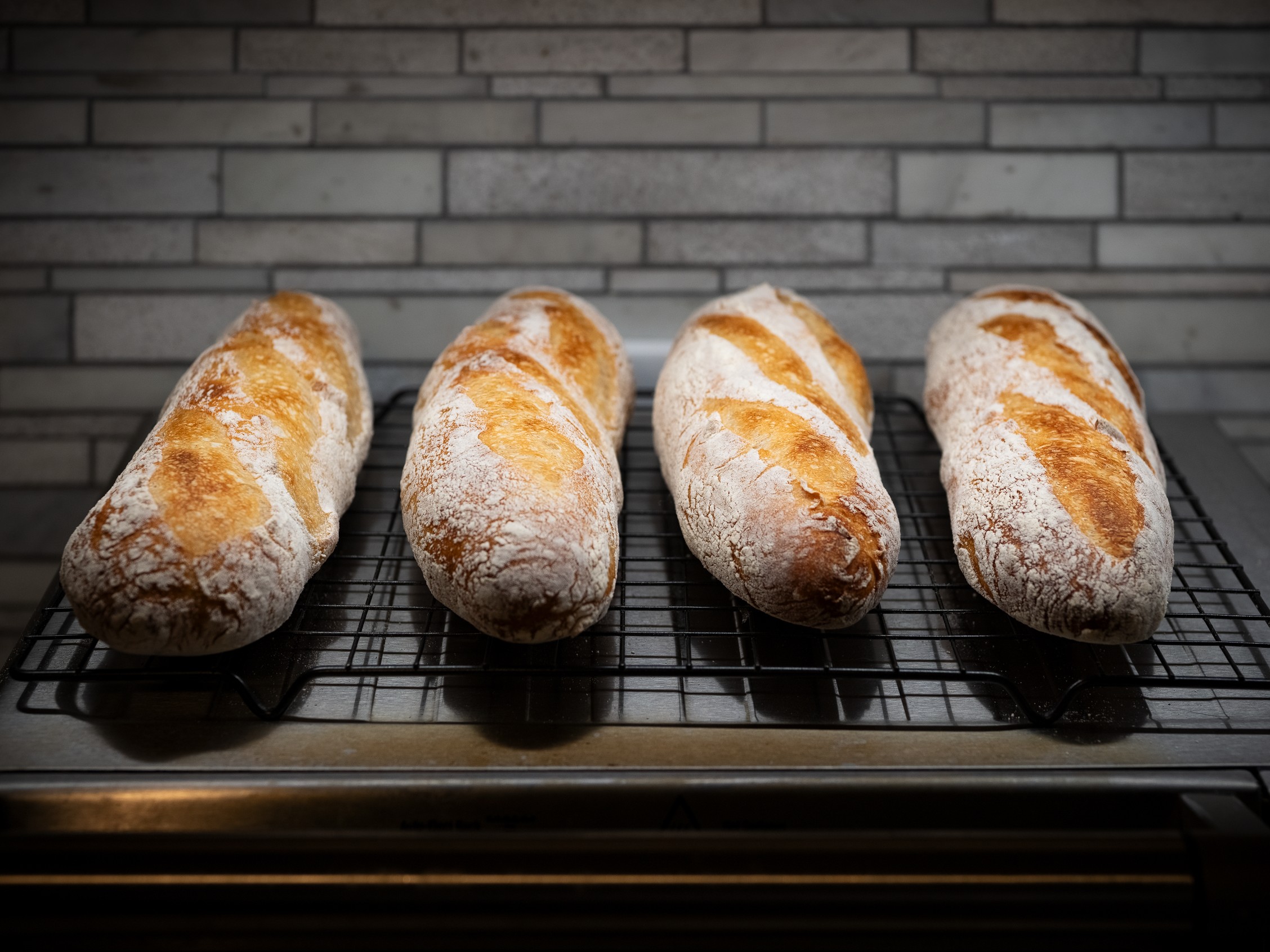
This photo showcases four sourdough baguettes on a cooling rack with a beautiful backdrop of brick tiles. The lighting is evenly distributed, highlighting the golden-brown crust that suggests a well-executed Maillard reaction. The baguettes exhibit impressive symmetry and consistent scoring with the characteristic 'ear' forming along their lengths. The cracks in the crust are artful and reflect a balanced hydration. However, the crumb is not visible in this shot, making it difficult to assess openness and structure.
**Golden Symmetry** This photo showcases four sourdough baguettes on a cooling rack with a beautiful backdrop of brick tiles. The lighting is evenly distributed, highlighting the golden-brown crust that suggests a well-executed Maillard reaction. The baguettes exhibit impressive symmetry and consistent scoring with the characteristic 'ear' forming along their lengths. The cracks in the crust are artful and reflect a balanced hydration. However, the crumb is not visible in this shot, making it difficult to assess openness and structure. The uniformity of the ear development on these baguettes indicates a successful scoring technique. Scoring allows the dough to expand in a controlled manner, directing the oven spring and preventing random bursts. For optimal results, score at a shallow angle and maintain consistency in depth and spacing. This not only enhances the visual appeal but ensures even baking. The crispy crust achieved in these sourdough baguettes is akin to the surface structure of volcanic rock. Both are the result of rapid cooling and drying, though on entirely different scales and contexts. Compared to previous bakes, the symmetry and scoring precision have noticeably improved, suggesting better handling and proofing techniques. The consistent coloration across all loaves speaks to even baking, possibly related to refined oven setup and timing adjustments. Still, evaluating the crumb would provide a fuller picture of internal fermentation success.