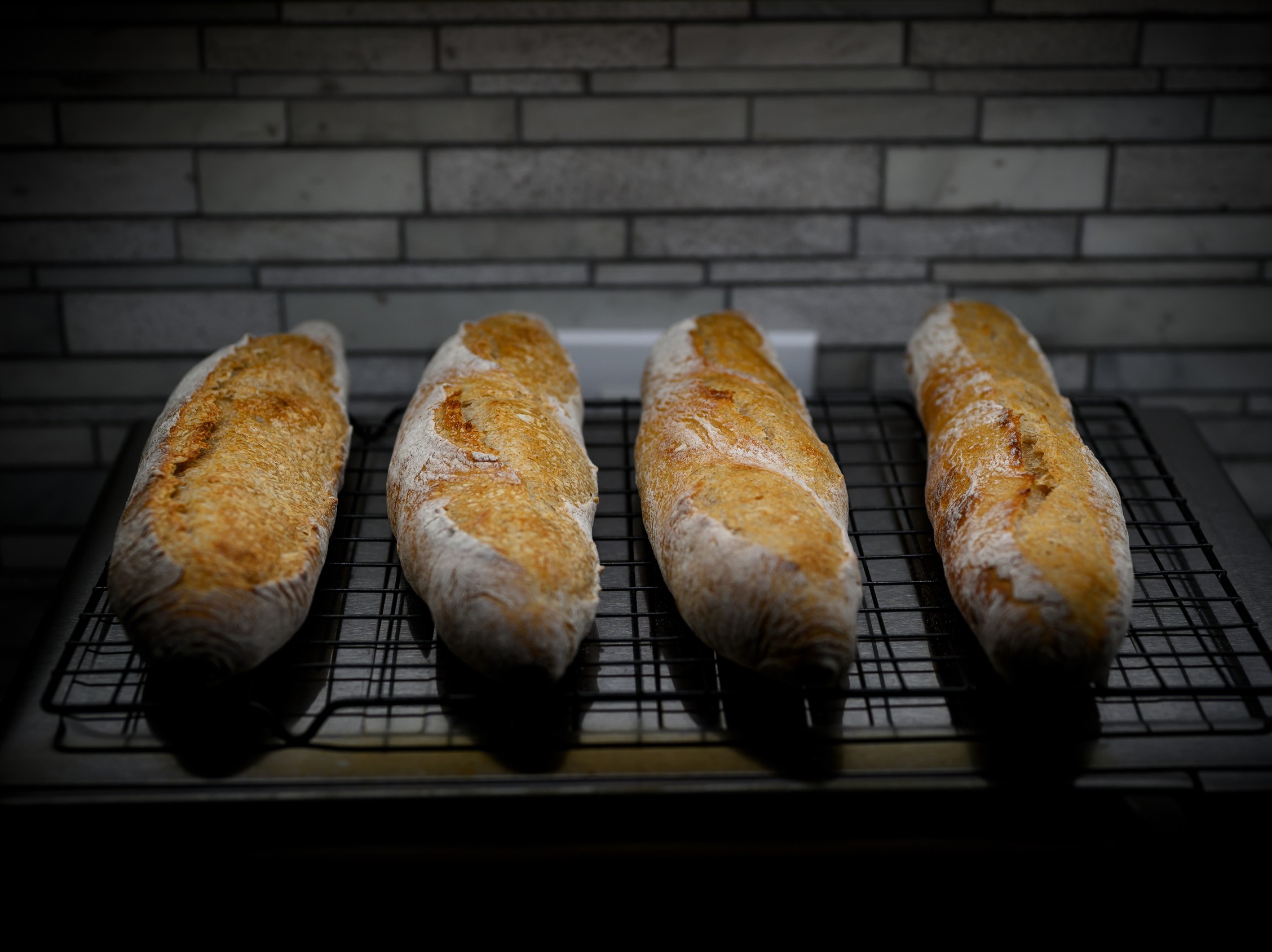
This photograph captures four sourdough baguettes on a cooling rack, framed by a textured tile backdrop. The soft lighting accentuates the crackled surfaces, highlighting the warm, golden hue of the crust. The scoring is distinct, though somewhat uneven, leading to a varied bloom across the loaves. The whole wheat addition is evident in the more robust texture of the crust. There's a slight asymmetry in the shaping, which could be improved for consistency. Overall, the fermentation looks well-executed, with reasonable oven spring.
**Earthy Forms** This photograph captures four sourdough baguettes on a cooling rack, framed by a textured tile backdrop. The soft lighting accentuates the crackled surfaces, highlighting the warm, golden hue of the crust. The scoring is distinct, though somewhat uneven, leading to a varied bloom across the loaves. The whole wheat addition is evident in the more robust texture of the crust. There's a slight asymmetry in the shaping, which could be improved for consistency. Overall, the fermentation looks well-executed, with reasonable oven spring. The use of whole wheat flour can lead to a denser crumb and a more robust crust. Here, the 20% whole wheat addition increases the dough's aptitude to retain moisture, leading to a thicker crust and influencing the overall chewiness. When using whole wheat, ensuring full hydration and proper gluten development through ample kneading and folding is vital. The baguette's elongated shape and crisp crust have origins in 19th-century France, with bakers incorporating steam-based techniques that revolutionized crust texture. Much like the evolution of guitar effects in progressive rock, these techniques transformed traditional expectations. Compared to previous attempts, this bake shows more consistent coloration and a better handle on texture due to improved hydration techniques. However, shaping symmetry still remains a challenge, which could be addressed by focusing on uniformity during the shaping phase.